
TOP PICK
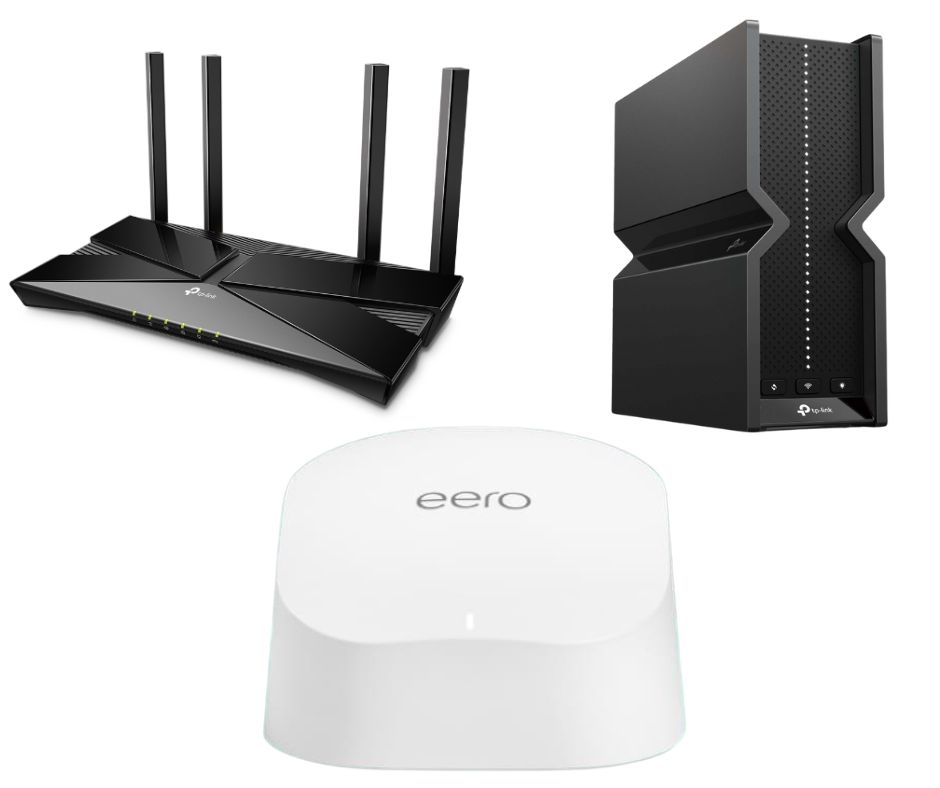
TP-Link Archer AX3000 Pro
This router created a speedy, responsive network throughout our test house. You have to spend a lot more on a router—or a mesh kit if you have a very large home—to get anything even a little better. It’s our latest Wi-Fi 6 (802.11ax) pick.

Most people don’t need “the fastest” or the most expensive router to get good internet. Hitting the sweet spot between price and performance, the TP-Link Archer AX3000 Pro, which usually costs $100 to $150, broadcast a reliable and responsive Wi-Fi 6 network in our test home. The Archer AX3000 Pro wowed us with a speedy Wi-Fi signal both close to and far away from the router, even when we simulated a whole family using Wi-Fi at the same time. It also has a moderate amount of future-proofing and is ready for a 1- or 2-gigabit internet connection, so you won’t need to replace it for at least another four, five, or even seven years.
TP-Link Archer BE550
The best router for gigabit internet
If you have gigabit or multi-gig internet service, or if you want to be ready for the latest technology, this Wi-Fi router is worth its higher price.

If you need a more future-proofed router that supports cutting-edge Wi-Fi technology, the TP-Link Archer BE550 is the one to buy. The Archer BE550 is more expandable and ultimately much faster than our pick. If you already have Wi-Fi 6E or Wi-Fi 7 phones or laptops in your home, or if you’re paying for multi-gig internet service, this upgrade is worth the extra $100.
Eero 6
For smaller homes
The Eero 6 smoothly delivers solid internet performance even while several people are using it simultaneously. It’s slower overall than our top pick for heavy downloaders and gamers, but this inexpensive router is expandable and a reliable option for a small home or an apartment.

The Eero 6 is easy to set up, inexpensive, and expandable into a mesh network if your needs grow. It provides a solid network for a small home or a multi-room apartment. It’s also one of the easiest routers to hide, on account of its tiny size. It’s the model we recommend if you want to spend under $90 on a new router but still want rock-solid coverage all over your living space.
We’ve found that the following features matter the most:
Current-generation technology: Since we look for routers that can improve your Wi-Fi, we consider only routers that support the Wi-Fi 6, Wi-Fi 6E, and Wi-Fi 7 standards. Any phone or laptop that you can buy today or may have bought in the past few years relies on one of these standards.
Good speed-test results: In our tests, network speed, or throughput, varies from “this YouTube video will never finish loading” to “you can download a video game update in an instant.”
Good range-test results: You should be able to connect to a well-placed router from anywhere in an apartment or a small house. We test each router to confirm whether it can stream high-quality videos to the far side of a living space.
Quick responsiveness: Slow internet sucks. Latency—or lag—is the time you have to spend waiting for the next thing to happen. A great router minimizes that wait even if the rest of the network is busy.
Multiple Ethernet ports: Ethernet ports give you unfettered access to the internet bandwidth you’re paying for.
Nice-to-have extras: Fast, reliable Wi-Fi is what matters the most, but more expensive routers add features that bring other benefits. The things we like to see that justify spending more include built-in security utilities and speedier Ethernet ports.
Price: You can buy a router for $20, and you can buy one for $800. But we don’t consider the cheapest or the fastest to be the best. When considering both features and our test results, we look for “the best for the most for the least.” Right now, paying around $130 for a router buys you excellent performance and features that offer real benefits.
Other Wi-Fi routers worth considering
If you have more technical needs: The Synology WRX560 is our former upgrade pick. Although this model remains an excellent router, it has been surpassed by the Wi-Fi 7–compatible TP-Link Archer BE550, which is future-proof, has additional 2.5 GbE ports, and is easier to set up. We still recommend the WRX560 for folks who want to set up a small-business network or need IT-level controls, such as the ability to configure and administer more than two named Wi-Fi networks on the same router.
If our pick is out of stock, and you want to try Wi-Fi 7: The TP-Link Archer BE230 is one of the dual-band Wi-Fi 7 routers we tested recently; these models lack the 6 GHz radio to save on price and complexity. Including a 6 GHz radio band allows for faster short-range communication, but the expense for the added radio is a must only if you already own Wi-Fi 7 mesh networks, phones, or laptops. The Archer BE230’s price of $100 to $200 is in line with that of our top pick, it performs admirably, and it lets you try out Wi-Fi 7–specific functions such as MLO (Multi-Link Operation, a setting on the router that shares both bands to make the Wi-Fi connection faster and more reliable). MLO isn’t enabled by default because it may not work with older Wi-Fi devices you have around the house. The BE230 lagged behind our top pick overall, so we don’t consider it a replacement at this time.